
Behind the numbers: disabled women building work on their terms
Disabled women are starting businesses faster than anyone else
Table of contents
The numbers behind the shift
Analysis of ONS data revealed that the number of self-employed disabled women increased by 66% from 2013 to 2019, with a rise of 12% (almost 30,000 women) in that last year alone [1]. This rate of increase surpassed that of disabled men during the same timeframe.
At that point, the total number of disabled self-employed people in the UK was 662,000, marking a whopping 41% increase since 2013 [1]. A more recent estimate suggests the current figure is approximately 611,000, which represents about 14% of all workers (with a growth rate of 30% over the past five years) [2].
What’s happened is that far more disabled people are in work at all now, partly because more people report having a disability than a decade ago, and partly because overall disability employment has grown substantially [3]. When more disabled women are working, more of them are choosing to work for themselves, and disabled workers remain consistently more likely to be self-employed than non-disabled workers.
Why more disabled women are choosing self-employment
Research backs up what a lot of us already know from lived experience. A review of 16 studies on disability and entrepreneurship found that flexibility and self-determination are one of the four core reasons disabled people choose to start their own business, alongside economic need, avoiding discrimination, and personal development [4].
An earlier study found that self-employment can offer disabled workers a way to accommodate a health condition that a fixed job often can’t (who knew, hey?) [5].
None of this is about disabled women being especially bold or unusually motivated. It’s about the basic shape of most workplaces. Fixed hours, fixed expectations, and fixed output don’t flex around fluctuating energy. Self-employment lets you build the shape of your work around your own capacity instead of trying to squeeze into someone else’s.
What building a business around fluctuating energy actually looks like
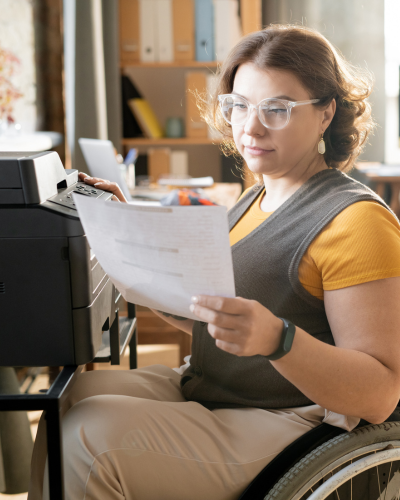
This isn’t about doing less and hoping for the best. It’s about structuring income, workload, and rest deliberately, so the business holds up even when your health doesn’t stay the same from one week to the next. That usually means pacing your output weekly (or daily in my case), building in strategic recovery time, and setting professional boundaries from the start rather than implementing them under pressure later.
Boundaries are usually the first thing to go when energy is limited, so it’s really important to make sure these hold firm when you most need them. That means deciding in advance what you will and won’t take on, how quickly you’ll reply to messages, and what a red flag looks like before you’re too deep into a project to say no. Scripts help here. Having a boundary written down before you need it means you’re not trying to find the right words while you’re already struggling.
A business that works with fluctuating energy also needs a money plan. That might mean pricing for the work itself rather than time spent, building in buffer months for lower-capacity periods, or choosing income streams that don’t all demand the same kind of energy at the same time. It is important to include the cost of adequate rest and recovery time in your hourly rate or project cost too.
What about tools & AI?
The right tools and systems matter too, but not in the way hustle culture sells them. The aim isn’t more automation for its own sake, it’s fewer decisions to make on a bad day and less admin sitting on your plate when your capacity is already stretched. A handful of tools that actually do their job will get you further than a stack of subscriptions you don’t have the energy to learn.
AI tools have a place here too. Used deliberately, AI can take on the parts of running a business that drain energy without needing your judgement, drafting first versions of emails or social posts, summarising a long document before you read it properly, or handling repetitive admin so your energy goes towards the decisions that actually need you. It isn’t a shortcut around building a solid business, and it won’t do the thinking for you, but it can protect the hours you do have.
This is the kind of thing I work through with women inside my Slow Business programme: Boundaries, slow business foundations, tools, slow marketing, and more.
The bottom line
The growth in disabled women’s self-employment isn’t a trend that will fade, and it isn’t a story about individual grit either. It’s what happens when workplaces built for fixed hours and fixed output meet a group of women who need something different, and go and build it themselves.
The rate of self-employment hasn’t shifted much for anyone, disabled or not, but the number of disabled women choosing this route has grown faster than almost any other group, because more of them are working at all, and because self-employment lets you shape a business around your own capacity rather than someone else’s expectations.
If you’re one of them, or thinking about becoming one, you don’t need to have it all worked out before you start. You need a way of building that holds up on the days your energy doesn’t, and that’s something you can put in place deliberately, one decision at a time.
If you’d like to find out more about how you can do this in a supportive community of chronically ill, disabled, and neurodiverse women, then check out my Slow Business Method programme.
Frequently asked questions about disabled women in self-employment
How many disabled women are self-employed in the UK?
IPSE analysis of ONS data found disabled women’s self-employment grew by 66% between 2013 and the time of the report, faster than the growth among disabled men [1]. Total disabled self-employment in the UK has been estimated at between around 611,000 and 662,000 people, depending on the year and source [1] [2].
Has the self-employment rate for disabled people gone up or down?
The proportion of disabled workers who are self-employed has fallen slightly, from 15.7% in 2013/14 to 13.2% in 2024/25. The same trend holds for non-disabled workers. However, disabled workers remain more likely to be self-employed than non-disabled workers throughout this period [3].
Why do disabled people choose self-employment more than employment?
Both research and anecdotal evidence point to flexibility as one of the main motives for self-employment among disabled workers, alongside economic need and the ability to accommodate a health condition that a fixed job structure often can’t [4] [5].
Do you need to disclose a health condition to start a business?
No.You don’t owe anyone an explanation of your chronic illness, health condition, disability, or symptoms to be self-employed or run a business.
How do you start a business while still employed?
Start small and start slowly. Identify what skills you already have, what income you need, and what a realistic timeline looks like. You don’t need to quit first. Building gradually is a strategy, not a compromise.
References
[1] IPSE (no date) The disabled self-employed data brief. Available at: https://www.ipse.co.uk/campaigns/disabled-self-employment/the-disabled-self-employed-data-brief (Accessed: 7 August 2026).
[2] IPSE (no date) Freelancing and self-employment with a disability. Available at: https://www.ipse.co.uk/advice/freelancing-and-self-employment-with-a-disability (Accessed: 7 August 2026).
[3] Department for Work and Pensions (2026) The employment of disabled people 2025. Available at: https://www.gov.uk/government/statistics/the-employment-of-disabled-people-2025/the-employment-of-disabled-people-2025 (Accessed: 7 August 2026).
[4] Norstedt, M. and Germundsson, P. (2023) ‘Motives for entrepreneurship and establishing one’s own business among people with disabilities: findings from a scoping review’, Disability & Society, 38(2), pp. 247-266. Available at: https://doi.org/10.1080/09687599.2021.1919504 (Accessed: 7 August 2026).
[5] Jones, M.K. and Latreille, P.L. (2011) ‘Disability and self-employment: evidence for the UK’, Applied Economics, 43(27). Available at: https://www.tandfonline.com/doi/abs/10.1080/00036846.2010.489816 (Accessed: 7 August 2026).
Get your weekly dose of calm and clarity
If you’re ready to protect your energy, The Weekly Pause is for you. Every Monday, I share gentle reminders, research-backed insights, and practical tips to help you work smarter, not harder.
The Slow Business Woman
Emm McAndrew knows what it means to juggle chronic illness, disability, neurodivergence and family life while running a business. She lives with ME, cPTSD, AuDHD, and cervical spondylosis, meaning she navigates sensory overwhelm, executive-function differences and family life while running a business.
The Slow Businesswoman provides information and education only. Nothing on this website, in blogs, emails, or courses should be considered medical, psychological, legal, tax, or financial advice, or a substitute for advice from a qualified professional who knows your circumstances. You remain responsible for your decisions; no liability is accepted for any loss or harm arising from use of the content. If you have concerns about a health or mental health condition, speak to your GP or another qualified clinician. Guest opinions are their own and do not necessarily reflect the views of The Slow Businesswoman.