
why burnout hits after time off
Signs of burnout on the job

When you take time off, we’re led to believe you’re meant to feel better.
But instead, you get home from the family holiday, the festive break, or even a long weekend, and your body says, “nope!”.
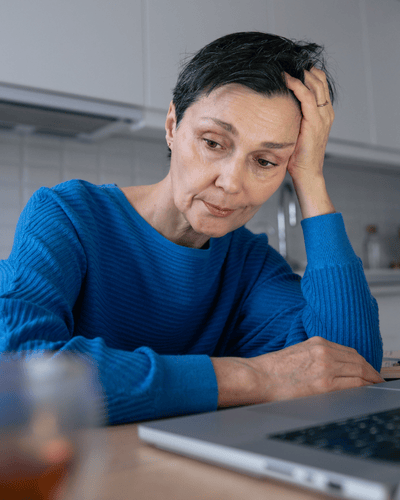
You’re more tired than before you left, you can’t focus, your chest feels tight, and you’re snappy with everyone. The thought of opening your laptop makes you feel sick.
That’s not you being dramatic; it could be burnout showing itself when you stop. Burnout is a syndrome caused by chronic workplace stress. It manifests as exhaustion, mental distance or cynicism, and reduced productivity. [1]
In plain terms, you’ve been running on emergency mode for too long, and the minute you remove the adrenaline and the routine, the costs land.
Table of contents
- The reasons burnout often shows up after time off
- The early signs you probably normalised
- Common lead-up patterns to burnout
- Why modern work is damaging our health
- What to do to next time you take time off from work
- How to give your brain and body the space to recover
- Next steps you can take
- Frequently asked questions (FAQs)
- References
Why burnout shows up after time off
Most people think burnout arrives like a dramatic collapse. In reality, it usually builds quietly, then becomes obvious when you stop.
Here’s what’s going on.
1. You’ve been propped up by work adrenaline
When you’re working, your day is structured. You’re “on”. You’re running on deadlines, people-pleasing, pressure, and urgency. Even if you feel awful, you can still push through because the environment forces you to.
Then you take time off. The pressure lifts. Your nervous system finally gets a chance to downshift. And the fatigue you’ve been overriding becomes impossible to ignore. Time off helps, but the effect is often short-lived if you go straight back to the same load
Research on holidays and recovery is blunt. Holidays do tend to improve wellbeing, but the benefit fades quickly after you return to work.[2] Another study found that burnout drops immediately after a holiday but often returns to pre-holiday levels within 4 weeks if work stressors remain unchanged.[3]
So if your work life is set up to drain you, a week off is not a fix. It’s a temporary relief.
2. Your body keeps score, even when your brain pretends everything is fine
Chronic stress doesn’t stay in your head. It affects sleep, digestion, inflammation, pain, immune function, mood, and memory. Stress research uses the term allostatic load, which is basically the wear and tear on the body from repeated stress activation over time.[4]
When you stop, your body isn’t thinking, “Nice, a break.” It’s thinking, “Finally, we can process the backlog.”
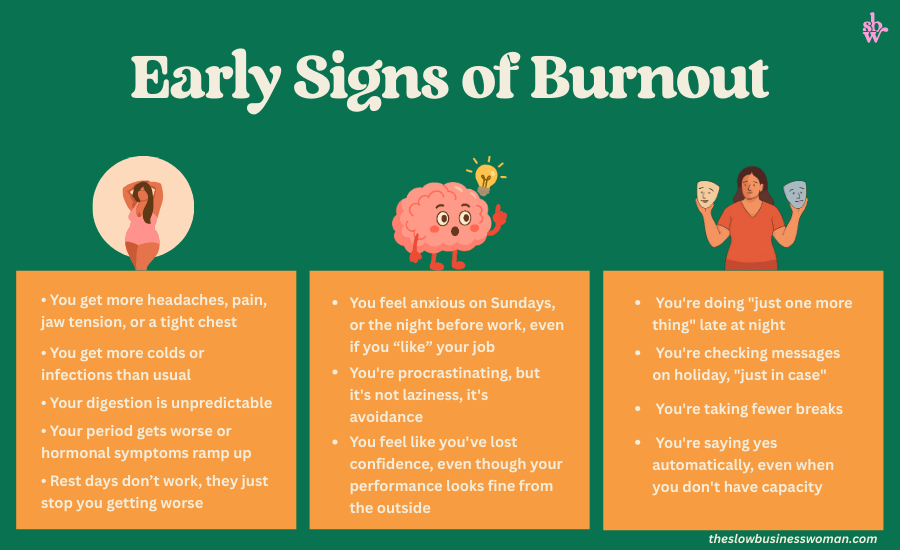
The early signs of burnout you might have normalised
1. Body signals
- You wake up tired, even after sleep
- You need caffeine just to feel human
- Your body feels heavy, like moving costs too much
- You get frequent headaches, muscle pain, jaw tension, or a tight chest
- You’re getting more colds, flares, or infections than usual
- Your digestion is unpredictable, or you’re living on sugar and beige food because it’s all you can manage
- Your period gets worse, or your hormonal symptoms ramp up
- You crash after “normal” tasks, like social plans, shopping, or a day out
- Rest days don’t refresh you, they just stop you getting worse
If you live with CFS/ME, fibromyalgia, long Covid, migraines, chronic pain, anxiety, depression, or any other energy-limiting condition, these symptoms matters more because your baseline is already lower. The margin for overwork is smaller and the consequences show up faster.
2. Brain signals
- You can’t concentrate unless it’s urgent
- Your memory is worse, you’re forgetting words, dates, and basic tasks
- You’re irritated by small things, and you don’t recognise yourself
- You’re more tearful, or emotionally flat
- You feel anxious on Sundays, or the night before work, even if you “like” your job
- You’re procrastinating, but it’s not laziness, it’s avoidance
- You feel like you’ve lost confidence, even though your performance looks fine from the outside
- You dread your inbox, Slack, WhatsApp, or anything that might contain a request
- You fantasise about quitting, disappearing, or being ill enough to justify stopping
3. Behaviour signals (the stuff that looks like “being organised”)
- You’re working longer hours because it takes you longer to do the same work
- You’re doing “just one more thing” late at night
- You’re checking messages on holiday, “just in case”
- You’re taking fewer breaks because stopping makes you realise how tired you are
- You’re saying yes automatically, even when you don’t have capacity
- You’re cancelling personal plans because work is draining you
- You’re “resting” with a screen, but it doesn’t feel like rest
- You’re keeping it all together for everyone else, then falling apart at home
This last list of symptoms is the biggest trap, because it’s socially rewarded. People will call you reliable, high-performing, “on it”. Meanwhile, you’re burning through the last of your reserves. This is exactly what happened to me.
If you’re reading this thinking, “That’s just normal life”, it isn’t. Burnout often looks like “normal” until your body can’t keep up. Burnout doesn’t usually start with exhaustion. It starts with a slow narrowing of your life.
Common "lead-up" patterns to burnout
1. You lose recovery time without noticing
Recovery time is the part of your day where your nervous system actually gets a chance to unwind. Not scrolling. Not “doing life admin”. Not lying on the sofa while worrying. When you live with limited energy, you’ll likely understand this already (if not, read about the neuroscience of rest here).
Real recovery tends to involve some combination of detachment from work, relaxation, a sense of control over your time, and doing something that makes you feel capable or interested again.[9]
In other words, your evening can be busy and still not be restorative. Once those recovery ingredients disappear, you can keep functioning, but you’re running on a deficit.
2. Your workload stops fitting your actual capacity
Your capacity is not your ambition. Capacity is what your body and brain can reliably handle without a crash.
Most workplaces, and plenty of businesses, assume an unlimited energy model. Full output, five days a week, all year, plus life admin, plus family, plus being “available”. That’s already unrealistic for healthy people. But for women with limited energy, it’s harmful.

3. You carry a hidden second shift
UK time-use data shows that women spend significantly more time per day on unpaid work, such as housework and caring responsibilities, than men. [10] So when someone says “Just rest after work”, many women laugh because they’re still working. Burnout isn’t only about your job, it’s about the total load.
4. You rely on coping strategies that work short-term
We often lean in to coping strategies that can keep us employed and praised. However, these also drive up allostatic load over time, which is linked to longer-term health impacts.[4]
Classic coping strategies are:
- Pushing through fatigue
- Perfectionism
- People-pleasing
- Over-functioning
- Masking neurodivergence or threat response
- Skipping breaks
- Using adrenaline as fuel
- Treating weekends/days off as recovery units (instead of usual down time)

Why modern work is damaging our health
The current way of working is built around capitalism, which values a high level of productivity instead of worker wellbeing, work sustainability, and long-term good health.
Long working hours are linked to serious health outcomes – a WHO and ILO analysis reported that working 55 hours or more per week is associated with a 35% higher risk of stroke and a 17% higher risk of terminal heart disease (compared to working 35 to 40 hours per week).[5] We need to change the midset that this is “a bit stressed”, when it’s proven to be a measurable increased risk of terminal health problems.
Work stress is also linked to cardiovascular risk – high demands and low autonomy at work, has been linked with increased risk of coronary heart disease in large-scale research.[7] Even when the effect sizes are described as modest, that’s still important because millions of people are exposed to these conditions for years. The way we work needs to change.
Burnout predicts wide-ranging health consequences
A systematic review of medical studies found burnout predicted a range of physical, psychological and occupational consequences, including things like prolonged fatigue, sleep issues, depressive symptoms, coronary heart disease, and musculoskeletal pain.[8]
So no, burnout is not “just feeling tired”. It’s a legitimate health risk. And here’s the key point: most people aren’t choosing these conditions freely. They’re responding to workloads, staffing levels, organisational expectations, digital overreach, and cultures that reward self-sacrifice. That’s why “just practise better self-care” lands like an insult. You can’t bubble-bath your way out of structural overload.
Why this hits women with limited energy harder
If you’re managing chronic illness, disability, neurodivergence, mental health challenges, or you’re a single mum, your risk profile is different. Not because you’re weaker, but because the system assumes you’ve got more energy than you actually have.
The recovery window is smaller
When your baseline energy is lower, you can’t keep paying back fatigue with one weekend. You need more frequent recovery time, and you need it earlier. If your only recovery is annual leave, you’re already in trouble. Your body may respond to exertion with delayed payback
People with conditions like ME/CFS and long Covid often experience post-exertional symptom worsening (PEM), where symptoms flare after physical or cognitive effort. Research on long Covid and post-exertional malaise shows how common these patterns can be, with fatigue and symptom exacerbation triggered by exertion, and not always in a predictable way.[12]
If you’re in this category, a “push hard then rest later” approach can backfire badly.
Masking costs energy
Autistic burnout has been described as resulting from chronic life stress and a mismatch between expectations and abilities, without adequate supports.[11] That mismatch is common in workplaces that reward constant availability, social performance, and sensory tolerance.
You can be capable and still get crushed by the cost of coping. So if you’ve ever thought, “Everyone else handles this, why can’t I?”, the answer is often that you’re spending more energy just to survive the day.
What to do differently next time you take time off
Step 1: plan for recovery, not just “being away”
Before you go, ask:
- What drains me most on trips, and how can I reduce it?
- What do I need to stop doing during this time off?
For many women, the holiday or time off becomes a relocation of labour. Packing, planning, managing kids, dealing with other people’s moods. If that’s you, you’re not getting a break, you’re doing unpaid project management in a nicer location, so get others to share the load, things that are going to mean personal time off for you, a slower travel plan, and no “making the most of it” pressure

Step 2: protect psychological detachment
Recovery research highlights detaching from work as one of the key experiences linked with recuperation.[9] That means:
- No checking emails “just to stay on top of things”
- No “quick replies”
- No admin disguised as rest
If you can’t fully detach because of your role, then contain it with things like a single, short check-in slot per day/week, a single device attached to work (one laptop, for example) so you don’t see messages in your down time, or use professional boundaries to keep your head out of work.
Step 3: don’t fill the gap with life admin
A lot of women use time off to catch up on everything they couldn’t do while working. That’s understandable, but it’s not restorative. Trying to do rest, life admin, and family logisitics in your time off is how you return to work more exhausted than when you left.
Step 4: build a softer landing, not a hard return
This is the one that changes everything. If you go straight from holiday into a full workload, your nervous system doesn’t transition. It slams into a brick wall.
A softer landing looks like:
- At least 1 buffer day at home before work restarts
- A low-meeting day as your first day back
- No deadlines within 48 hours of return
- A staggered restart, not a full sprint
If you’re self-employed, you can design this using The Slow Business Method. If you’re employed, you can request it.

How to recover if you've already hit a wall
If you’re already at the stage where time off has revealed how bad things are, you need to do two things at the same time: reduce load and increase recovery. If you only add recovery but keep the same load, you’ll keep sliding back into burnout.
1. Identify the things that drain you
Write these down then look at ways to reduce them as soon as possible. This could be things like:
- Fewer client calls
- Less social obligation
- Reducing screen time at night
- No constant messaging/being available to everyone
The goal isn’t perfection, it’s to see a measurable reduction in things that are draining you.
2. Create daily recovery slots that are small enough to be real
If you wait for “a full day off”, you’ll never recover while life is still happening. Instead try some of the following.
- Two minutes of stillness
- A ten-minute lie down with no screen
- A short walk with no audio
- A warm shower with your phone outside the room
- Sitting with a hot drink and no tasks attached
I know that these sound basic, but they matter because you’ll be teaching your nervous system to come down repeatedly, instead of only collapsing when it’s forced to.
3. Fix your “rest”, because a lot of it probably isn’t rest!
If your rest involves doom-scrolling, double-screening, going through the mental load while “relaxing”, catching up on emails (work or personal), or using your day off to cater to everyone else’s needs, then you’re not giving your brain the conditions it needs to recover. This is where the neuroscience matters -your brain needs genuine downshifts, not just stopping work while staying mentally activated.
4. Stop treating warning signs as personality flaws
Burnout makes you think you’re lazy, unmotivated, that you’re failing or have lost your “edge” and that story keeps you pushing on. A question we can ask ourselves at the time is, what would change if I treated these symptoms as signals, not weaknesses?
5. A safer return-to-work plan after time off (especially if you’re already depleted)
If you’re going back to work and already struggling, don’t aim for a perfect comeback. Aim for damage limitation.
Days 1 to 3: stabilise
- Do the minimum viable work
- Block focus time, reduce context switching
- Say no to anything non-essential
- Take breaks before you feel you “need” them
- Eat real food, even if it’s basic
- Leave work on time, even if things are unfinished
Week 1: reduce exposure to the worst stressors
- Cut meeting time where possible
- Push non-urgent deadlines
- Batch communications
- Set a clear message boundary, and stick to it
- Ask for support, even if it feels awkward
Week 2 onwards: redesign your systems
This is the part most people skip. They survive the first week, then drift back into the same overload! If you want this to stop happening, something has to change: your workload/hours, your role expectations, professional boundaries, your capacity planning, and “availability” assumptions.
Next steps you can take today
Read more about burnout
A deeper dive into how burnout shows up for women and how to recover.
Watch my video on returning to work after the festive break
This 20-minute video replay explains why going back to work feels so heavy after the festive break (but the advice works ofr other holidays too).
Work for yourself
If rest doesn’t “work” for you, it’s often because you’re not actually getting nervous system downshift time.
If you’re ready to rebuild how you work – The Slow Business Method is the structured route out of recurring burnout cycles, especially if your energy is limited.
FAQs about burnout on the job
What are the common signs of burnout?
Common signs include persistent exhaustion, brain fog, irritability, sleep disruption, increased cynicism, reduced confidence, and needing more effort to do work that used to feel manageable. [1][8]
Why do I feel worse after holiday or time off?
Time off can remove the adrenaline and structure that helped you push through. Research shows holidays can improve wellbeing, but the effect often fades quickly once work resumes, especially if you return to the same stressors. [2][3]
How do I know if it’s burnout or just normal tiredness?
Normal tiredness improves with rest. Burnout tends to persist, affects mood and cognition, and comes with a sense of depletion and disconnection from work. [1]
Can burnout cause physical symptoms?
Yes. Research links burnout with physical and psychological outcomes including prolonged fatigue, sleep problems, musculoskeletal pain, and cardiovascular-related outcomes. [8]
Does working long hours really affect health?
Yes. WHO and ILO reporting links working 55+ hours per week with higher risk of stroke and ischaemic heart disease compared with standard working hours. [5]
Is burnout worse if I have chronic illness, disability, or neurodivergence?
It can be, because your baseline energy is lower and recovery can take longer. Some groups also face higher daily load from masking, sensory stress, or delayed symptom worsening after exertion. [11][12]
What helps burnout recovery the most?
Recovery usually requires reducing the source of overload and increasing genuine recovery time. Research on recovery experiences points to detaching from work, relaxation, having control over leisure time, and doing activities that rebuild a sense of competence. [9]
How can I prevent burnout after time off?
Build a softer return, reduce immediate workload, and change what you return to. Holidays help briefly, but if the work system stays the same, burnout often rebounds within weeks. [3]
What should I do if my workplace won’t reduce my workload?
Treat that as information. If the job requires ongoing self-sacrifice, your options are boundary renegotiation, role redesign, formal adjustments, or a longer-term exit plan. Your health isn’t negotiable. You could think about working for yourself which would allow more freedom – see how to start your own business when you have limited energy, here.
Is burnout a medical condition?
Burnout is classified by WHO as an occupational phenomenon rather than a medical condition, but that doesn’t make it harmless. It can still have serious health impacts and may overlap with anxiety, depression, and chronic stress responses. [1]
References
[1] World Health Organisation (2019). Burnout: an “occupational phenomenon”: International Classification of Diseases. Available at: https://www.who.int/news/item/28-05-2019-burn-out-an-occupational-phenomenon-international-classification-of-diseases (Accessed: 4 January 2026).
[2] de Bloom, J., Kompier, M.A.J., Geurts, S.A.E., de Weerth, C., Taris, T.W. and Sonnentag, S. (2009) ‘Do we recover from vacation? Meta-analysis of vacation effects on health and wellbeing’, Journal of Occupational Health, 51(1), pp. 13–25. doi:10.1539/joh.k8004.
[3] Westman, M. and Etzion, D. (2001) ‘The impact of vacation and job stress on burnout and absenteeism’, Psychology and Health, 16(5), pp. 595–606. (Indexed on PubMed: https://pubmed.ncbi.nlm.nih.gov/22804501/) (Accessed: 4 January 2026).
[4] McEwen, B.S. (1998) ‘Stress, adaptation, and disease: allostasis and allostatic load’, Annals of the New York Academy of Sciences, 840, pp. 33–44. doi:10.1111/j.1749-6632.1998.tb09546.x.
[5] World Health Organization (2021) Long working hours increasing deaths from heart disease and stroke: WHO, ILO. Available at: https://www.who.int/news/item/17-05-2021-long-working-hours-increasing-deaths-from-heart-disease-and-stroke-who-ilo (Accessed: 4 January 2026).
[6] International Labour Organization (2021) Long working hours can increase deaths from heart disease and stroke, say ILO and WHO. Available at: https://www.ilo.org/resource/news/long-working-hours-can-increase-deaths-heart-disease-and-stroke-say-ilo-and (Accessed: 4 January 2026).
[7] Kivimäki, M., Nyberg, S.T., Batty, G.D., et al. (2012) ‘Job strain as a risk factor for coronary heart disease: a collaborative meta-analysis of individual participant data’, The Lancet, 380(9852), pp. 1491–1497. (Open access via PMC: https://pmc.ncbi.nlm.nih.gov/articles/PMC3486012/) (Accessed: 4 January 2026).
[8] Salvagioni, D.A.J., Melanda, F.N., Mesas, A.E., González, A.D., Gabani, F.L. and de Andrade, S.M. (2017) ‘Physical, psychological and occupational consequences of job burnout: A systematic review of prospective studies’, PLoS ONE, 12(10), e0185781. doi:10.1371/journal.pone.0185781.
[9] Sonnentag, S. and Fritz, C. (2007) ‘The Recovery Experience Questionnaire: development and validation of a measure for assessing recuperation and unwinding from work’, Journal of Occupational Health Psychology, 12(3), pp. 204–221. doi:10.1037/1076-8998.12.3.204.
[10] Office for National Statistics (2023) Time use in the UK: 23 September to 1 October 2023. Available at: https://www.ons.gov.uk/peoplepopulationandcommunity/personalandhouseholdfinances/incomeandwealth/bulletins/timeuseintheuk/23septemberto1october2023 (Accessed: 4 January 2026).
[11] Raymaker, D.M., Teo, A.R., Steckler, N.A., et al. (2020) ‘”Having all of your internal resources exhausted beyond measure and being left with no clean-up crew”: Defining autistic burnout’, Autism in Adulthood, 2(2), pp. 132–143. doi:10.1089/aut.2019.0079.
[12] Stussman, B., Camarillo, N., McCrossin, G., et al. (2025) ‘Post-exertional malaise in Long COVID: subjective reporting versus objective assessment’, Frontiers in Neurology, 16, 1534352. doi:10.3389/fneur.2025.1534352.
Get your weekly dose of calm and clarity
If you’re ready to protect your energy, The Weekly Pause is for you. Every Monday, I share gentle reminders, research-backed insights, and practical tips to help you work smarter, not harder.

The Slow Business Woman
Emm McAndrew knows what it means to juggle chronic illness, disability, neurodivergence and family life while running a business. She lives with ME, cPTSD, AuDHD, and cervical spondylosis, meaning she navigates sensory overwhelm, executive-function differences and family life while running a business.
The Slow Businesswoman provides information and education only. Nothing on this website, in blogs, emails, or courses should be considered medical, psychological, legal, tax, or financial advice, or a substitute for advice from a qualified professional who knows your circumstances. You remain responsible for your decisions; no liability is accepted for any loss or harm arising from use of the content. If you have concerns about a health or mental health condition, speak to your GP or another qualified clinician. Guest opinions are their own and do not necessarily reflect the views of The Slow Businesswoman.